Teeth whitening for sensitive teeth. Is it possible?
Is it safe?
What will be the outcomes?
This makes people think twice about getting the treatment. Plenty of people with sensitive teeth skip whitening because they expect pain. But don’t lose heart. You can also get it done after talking with your dentist. Therefore, plan it with your dentist through thorough discussion. He will surely find a way.
Whitening Sensitivity: What It Is and Why It Happens
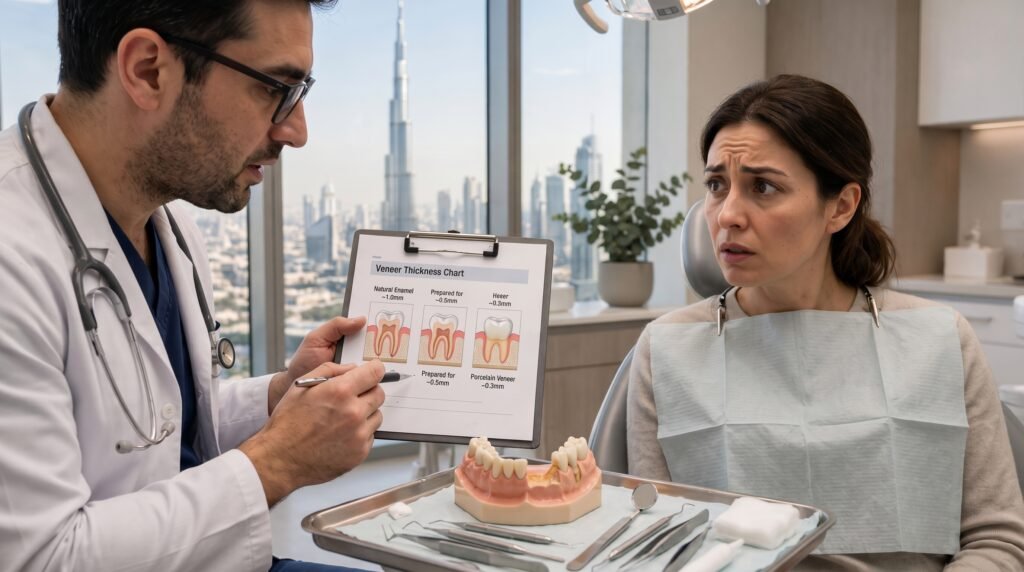
Whitening gels work by passing through the tooth’s hard outer layers. Whitening agents can penetrate enamel and dentine. This may cause hypersensitivity. The usual explanation is that fluid moves inside tiny channels in the dentine, which stimulates the tooth’s nerve.
In almost 50% of cases, it is expected that the patient will get sensitivity issues after a teeth whitening procedure. Dentist already know this thing so they tell the patient before and also guide them that how to deal with it because this sensitivity is not permanent, it is temporary which needs management to certain time limit. After that, things settle down. Some patients have a mild issue, while some have a bit more.
Cold sensitivity is usually the most common side effect. It is short, sharp twinges from:
- Cold air
- Cold drinks
Discomfort typically peaks within the first 24 to 48 hours and usually resolves within 24 to 72 hours. People with thinner enamel or gum recession may feel tenderness for up to a week.
Who should be careful?
Experts recommend screening every patient for sensitivity risk before whitening. Patients who are in higher-risk groups are people with:
- Existing sensitivity
- Gum recession
- Thin enamel
- Existing restorations such as fillings
- Drink a lot of acidic drinks
- Have worn or eroded enamel.
Some problems must be treated first for safe whitening in Dubai:
- Active decay
- Gum disease
- Cracked enamel
If a patient has some hidden dental issue and tooth whitening is done, it can cause problems later. Therefore, an analysis of teeth is required for which you should consult your dentist at the first hand. Who properly scans and checks for any hidden dental problems, if he suspects any, then suggest teeth whitening procedure.
Your options for teeth whitening for sensitive teeth
There are two main routes that people with sensitive teeth can use with the right adjustments after consulting their dentist.
| Option | How it works | Sensitivity angle |
| In-chair (professional) | The dentist uses a desensitizing whitening method and applies a stronger gel in a single visit | Gums are protected, and a desensitising product can be applied |
| Take-home custom trays | Trays made for the person’s teeth hold gel worn at home | A dentist may start sensitive patients on a lower-concentration take-home system, with 10% carbamide peroxide as an example |
The in-chair procedure, step by step
01. Check-up
The dentist examines the teeth and gums for:
- Decay
- Cracks
- Leaking fillings
- Inflamed tissue
- Plaque
- Surface stains
Teeth need to be clean before commencing the whitening process because plaque and stains can interfere with results.
02. Shade check
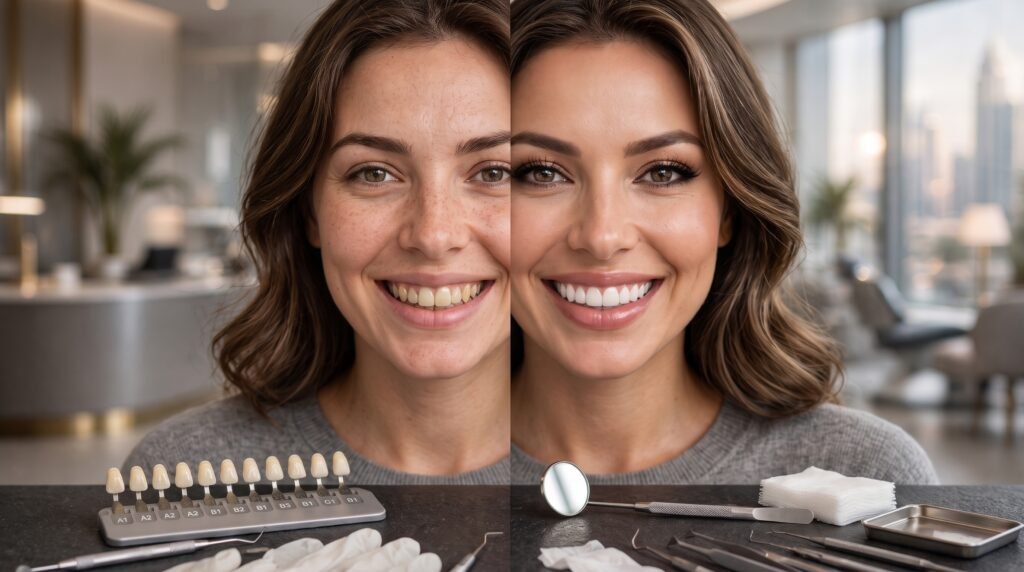
A shade guide is held beside the teeth, and the closest match is recorded, often with a photo, so the results can be compared later.
03. Protection
A retractor holds back the lips and cheeks, and cotton keeps saliva off the teeth. A resin barrier is painted along the gumline and hardened with a light.
04. Gel
For a fixed amount of time, the front of each tooth is coated with whitening gel, which is then cleaned off. This is usually repeated two or three times in the visit.
05. Rinse and finish
The barrier is peeled away, and the teeth are rinsed. A desensitising or fluoride product may be applied.
06. Shade comparison
The shade of teeth after treatment is compared with the one before treatment.
07. Aftercare advice
The dentist gives useful suggestions to the patients that what they should avoid and what they can use at home for keeping results longer and manage temporary tooth sensitivity if arise.
The whole procedure roughly takes 60 to 90 minutes, with two hours as the maximum. Each gel application stays on for about 15 to 30 minutes and uses hydrogen peroxide at roughly 15 to 35%. That is a rough estimate, so the dentist’s own protocol may differ.
The result can look slightly lighter right after treatment, and it settles over 48 to 72 hours. In some cases, the shade may soften as the true shade settles over the next day or two.
Desensitising whitening
Several steps can lower the chance or the strength of sensitivity.
Before treatment
- Potassium nitrate toothpaste: Patients at risk can start one before whitening, and it may take about four weeks to begin working. It is better to start two to four weeks ahead.
- Fluoride: Fluoride varnish or daily fluoride toothpaste may reduce the risk.
- Less acid: Experts advise cutting back on acidic drinks in the days before.
During treatment
- Gum protection: The barrier and custom trays help keep gel off the gums.
- Desensitising gel: A drop of potassium nitrate and fluoride gel, or a calcium agent, can be placed in the tray for 10 to 20 minutes.
- Adjusted plans: If sensitivity appears, it is suggested to use shorter contact times, less frequent sessions, and careful gum protection.
After treatment
- Keep using a desensitising toothpaste. Use it for a week and two times in 24 hours.
- Avoid very hot or very cold food and drink for 24 to 48 hours.
- Use a soft brush, since firm pressure can aggravate sensitivity.
- Avoid staining foods and drinks such as coffee and red wine for 48 hours.
What is normal, and when to call the dentist
Some sensitivity and slightly sore gums are common and usually settle over a few days. The signs to take seriously are:
- Throbbing or sharp pain in treated teeth that lasts more than a few days and wakes the person at night, or is triggered by heat or biting
- Any sore on the gums or lips that spreads, starts bleeding, or hangs around for more than a few days
- Sensitivity that gets worse after the first week
What to check for safe whitening in Dubai
For anyone searching for safe whitening Dubai clinics offer, a few practical questions help.
- Is there a check-up first i.e. a proper exam for decay, gum disease, and cracks should come before any gel.
- Is the plan written for sensitive teeth? Ask about desensitising steps and a lower-strength option to your dentist.
- Is the gum barrier used?
- Is the dentist licensed?
- All costs are mentioned or not, and what is included in it e.g., trays that can be taken home and follow-up checkups.
When you go to the clinic, they will provide you with every detail after checking the condition of your teeth. Therefore, the confusion about prices and whether you are eligible for a whitening procedure or not vanishes.
Conclusion
A proper talk with the dentist is what you need to decide whether you can get teeth whitening for sensitive teeth or not. At dental clinics like Klinika Dental Clinic in Dubai, you are examined by an expert properly. He will discuss your issues and see what fits best to proceed with the procedure so you can get safe whitening treatment with positive results.
FAQs
01. Can people with sensitive teeth have their teeth whitened?
Yes, people with sensitive teeth can also get teeth whitening procedures, but after a good discussion with their dentist. Their dentist will discuss their sensitivity issue with them and help them take safety measures before the procedure.
02. Why does whitening make teeth sensitive?
Whitening agents can pass through the enamel and the layer beneath it (dentine), which may cause sensitivity. The whitening fluid moves inside tiny channels in the dentine and stimulates the tooth’s nerve.
03. How common is whitening sensitivity?
It’s expected, and dentists know it and inform patients before the procedure. Almost 50% of patients experience it, and it is mild to severe but not permanent. Resolve gradually, only care is needed which dentists instructs after procedure.
04. How long does the sensitivity last?
Sensitivity prevails for some days. It is not permanent. 24 to 48 hours are its peak times, and usually it begins to disappear within 24 to 72 hours, though people with thin enamel or gum recession may feel tenderness for up to a week.
05. Who is more likely to have sensitivity?
People with:
- Existing sensitivity
- Gum recession
- Thin enamel
- Existing restorations such as fillings
- Habit of drinking a lot of acidic drinks
- Worn or eroded enamel