Not every dental problem is a big one. Many dental issues stay limited to one spot, like a cavity in just one tooth or a single chipped tooth. Others are everywhere at once, like:
- Teeth worn flat
- Old fillings failing
- Gaps where teeth are missing
- A bite that no longer feels right
When you have multiple issues, or your whole mouth has dental problems, it is hard to fix one tooth at a time. That does not make sense. This is exactly where a person needs full mouth rehabilitation that Dubai clinics provide. The motive is to:
- Restore the ability to chew comfortably
- Protect remaining teeth from further damage
- Bring the top and bottom teeth into better contact when the mouth closes
- Support healthy gums and jaw joints
- Create a smile that looks natural and balanced
What is full mouth rehabilitation?
Prosthodontists describe it as:
- Restoring or replacing the full set of teeth
- Bringing cosmetic and restorative treatments together to improve health, function, and looks
In simple terms, it is one coordinated plan for the whole mouth, not a string of separate repairs.
Note that the same treatment is known by two names. Clinics may use them interchangeably:
- Full mouth reconstruction
- Full mouth rehabilitation
Whichever name a clinic uses, the treatment deals with all of the teeth.
Could this be you?
The following reasons can make you eligible for this treatment plan:
- Multiple missing teeth
- Many failing or decayed fillings
- Cracked or broken teeth
- Heavy wear from grinding or other habits
- Sore or sensitive teeth
- A bite that has stopped feeling comfortable
- A smile the person dislikes and wants to rebuild through complete smile restoration, alongside some of the problems above.
Having one of these on its own doesn’t mean full mouth reconstruction is the answer. It’s the combination, and the way the problems affect each other, that usually leads a dentist to suggest a whole-mouth plan. A full check-up of the whole mouth lets a dentist see whether this treatment is needed.
Worn teeth need a fix first.
When a tooth begins to wear, it is hard to reverse it naturally because once the tooth material is worn off, it donot reconstruct on its own. A dentist needs to repair it by applying a dental material to reconstruct the tooth. Such patients prefer full-mouth restoration if more than one tooth is damaged by wear. But before restoration, knowing the reason behind tooth wear is necessary, which could be due to the following reasons:
- Mechanical
- Chemical
- Biomechanical
According to earlier research, about 30 to 45% of adults have moderate tooth wear, and around 10 to 15% have severe wear.
Here are the main causes:
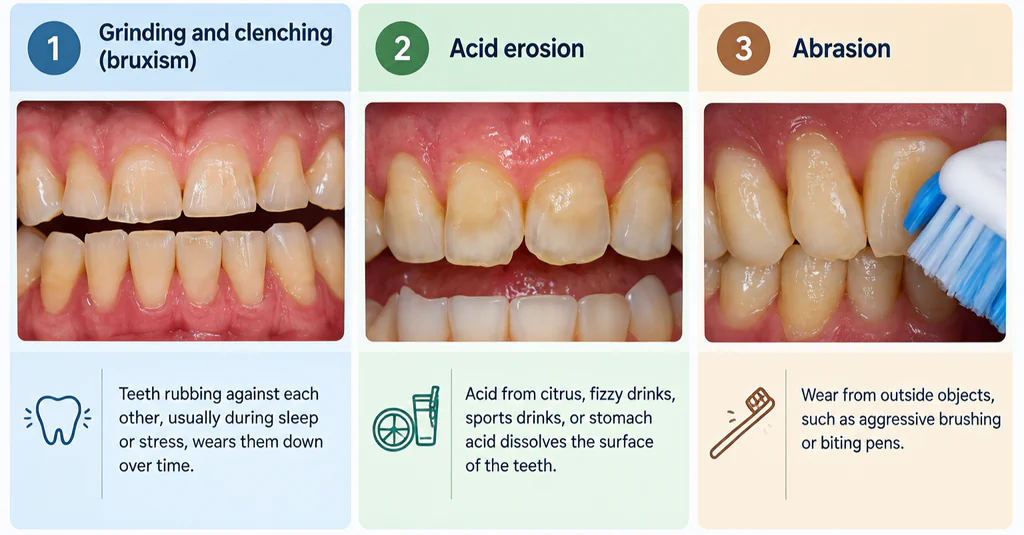
So the dentist should begin the restoration plan with the worn teeth treatment. This matters for one big reason. Otherwise, the new implant will also have to face wear and tear after successful installation. which patients surely do not want to have.
The worn teeth treatment can be started by making patients aware of their certain damaging habits and asking them to take these precautionary measures:
- Night guards
- Gentler brushing
- Cutting down on acid
Why missing teeth is a problem
A missing tooth leaves more than a gap. One after another, it can cause various dental problems:
- Without a tooth to support it, the jawbone in that spot can slowly shrink.
- Nearby teeth can drift into the space.
- Teeth can end up meeting in the wrong places, which makes biting and chewing feel off.
- The jaw joint can become sore or stressed.
When a patient is facing more than one dental issue like these, fixing each of them separately could be hectic and a waste of time, so a full-mouth restoration plan works.
What might the complete smile restoration include?
It includes a combination of different dental treatments that dentists suggest after analyzing and diagnosing the patient’s mouth.
| Treatment | What it does |
| Crowns | Caps that cover and protect a damaged or worn tooth |
| Onlays | Covers only part of a tooth when a full crown isn’t needed. |
| Bridges | Replaces missing teeth by attaching to the teeth next to the gap or to implants. |
| Veneers | Slim covers placed over the front teeth to make them look better. |
| Dental implants | Artificial roots that support crowns, bridges, or dentures |
| Dentures | Removable or fixed replacements for missing teeth |
| Orthodontics | Braces or aligners are used to gradually move teeth to the desired point |
The journey, step by step
The exact order is set by the treating team, and some stages overlap.
01. Assessment and planning
The dentist examines every tooth by:
- X-rays
- 3D scans
- Checking the bite
A mock-up or digital preview may be used to show the planned result.
02. Getting the mouth healthy
Under this:
- Gum treatment is provided
- Root canals are done
- Those teeth that cannot be saved are checked and extracted
03. Building up, if needed
Before the final implant, gum grafting or bone grafting may also be done, only in patients who need it.
04. Implants, if needed
Implants are placed and given time to bond with the bone.
05. Temporary teeth
These are worn during treatment and act as a test run for the bite, speech, and appearance.
06. Final restorations
When the dentist is assured that all other needed mouth repair is completed, the permanent teeth are:
- Made according to mouth size
- Fitted
- Adjusted
The temporary stage is more important than it sounds. Changing a temporary tooth is quick, while remaking a final crown is slow, so dentists test the bite and look with temporaries first.
How long does it take?
It can take several months and, in some cases, a year or maybe more. A plan without grafting may finish within several months to a year, while one involving grafting on both jaws often runs beyond a year.
Here are some estimates:
- Crowns and veneers alone usually take about 4 to 12 weeks.
- A moderate rehabilitation can run for about 3 to 5 months.
- Implants without bone grafting take roughly 4 to 6 months
- When a full-arch plan needs bone grafting, expect roughly 9 to 14 months, with some cases running past that.
Who does the work?
Full mouth rehabilitation is a team effort. A prosthodontist is the major figure in this plan who is often accompanied by a team of other dental specialists such as:
- Gum specialists
- Oral surgeons
- Orthodontists
Choosing the right team for full mouth rehabilitation in Dubai
Anyone considering full mouth rehabilitation Dubai should treat the first consultation as a way of judging the team as much as the treatment. A few practical questions help:
- Is the dentist licensed to practise in Dubai?
- Is a prosthodontist leading or closely involved in the plan?
- Will the plan be written down, with:
- Phases
- the number of visits
- a rough timeline
- Are temporary teeth part of the process, and how long will they be worn?
- Will the cost be itemised, so each treatment and material is listed?
- Does the clinic explain alternatives, including treating fewer teeth?
The cost of full mouth reconstruction depends on the plan of treatment, i.e., what procedures are needed by a patient. Therefore, sit with your dentist and ask him to explain the plan to you, along with the cost of each procedure that will be performed. This will be helpful for your dentist and for you as well in:
- Setting a budget
- Completing the procedure without any interruption
Conclusion
A full mouth rehabilitation Dubai people need is a big thing to decide on. If you are confused, simply contact a dental clinic like Klinika Dental Clinic in Dubai. They have an expert team of prosthodontists and other dental specialists who can help you reach a conclusion on whether it is right for you or not.
FAQs
01. Is full mouth rehabilitation the same as full mouth reconstruction?
Both terms are correct for this plan, as both include treatment for all of the teeth in the mouth. Clinics use any of these terms.
02. Who may need it?
It may suit people with several problems at once, such as:
- Multiple missing teeth
- Many failing fillings
- Cracked or broken teeth
- Heavy wear from grinding
- Painful or sensitive teeth
- A bite that no longer feels comfortable
One problem alone usually doesn’t call for it. What exact needed is decided after proper examination by a dentist.
03. What treatments can be part of the plan?
It may include:
- Crowns
- Onlays
- Bridges
- Veneers
- Dental implants
- Dentures
- Orthodontics, i.e., braces or aligners
A patient may need only a few of these or most of them, depending on the case.
04. How long does full mouth rehabilitation take?
Approximate time depends on the plan:
- 4 to 12 weeks for crowns and veneers only
- 3 to 5 months for moderate cases
- 4 to 6 months for implants without bone grafting
- 9 to 14 months or more for full-arch work with bone grafting
05. Can the whole treatment be done in one day?
It is not possible to finish the full mouth reconstruction in one day, as it includes several small dental treatments that take time. Dentists perform them one by one. However, temporary teeth can sometimes be fitted on the day of surgery.