Before getting veneers, people worry about the thing that do veneers damage teeth. According to veneer application procedures described online, a layer of natural tooth is removed to place veneers, which confuses patients.
People often worry about losing part of their natural tooth, and about what happens if a veneer chips or breaks. All these thoughts affect the decision of a person to get veneers. However, dentists are here to help you and guide you in the right way. Assumptions and fears about this treatment vanish once a patient clearly discusses things with their dentist.
Veneers aren’t automatically harmful, but the usual kind does involve a permanent change to the tooth. Let’s discuss the matter in detail.
Let’s understand veneers and their function.
Veneers are thin shells, usually made of porcelain or a tooth-coloured resin, that cover the front surface of a tooth. They work like a fresh outer layer, so the tooth looks different while the tooth itself stays in place.
Their main job is to:
- Improve appearance
- Cover chips and cracks
- Close small gaps
- Hide stains that whitening can’t fix
- Make teeth look more even in shape and colour
- Give a brighter, neater smile
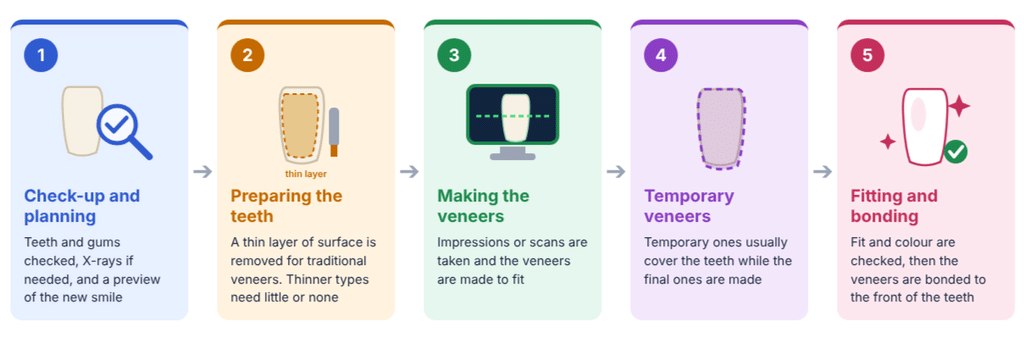
How veneers are put on
The whole procedure is completed in two or three visits.
What is being removed?
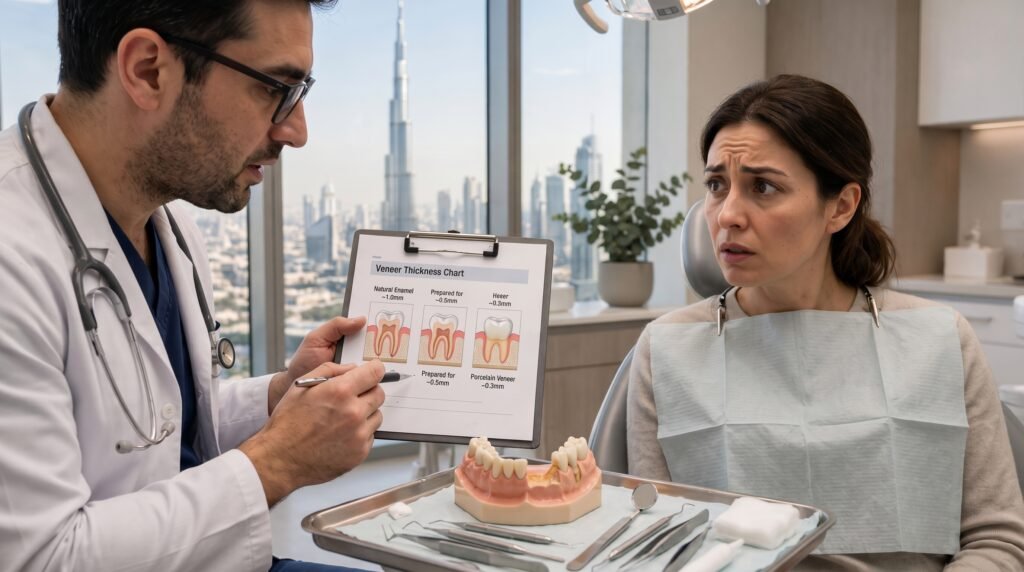
Enamel is the hard outer shell of a tooth, which is removed in a thin layer so a space is created to settle the veneer in a way that it is not visible or feels like something is placed on the tooth. The edges of the veneer are completely blended with the tooth so that it looks natural.
Point here to worry is that enamel doesnot contains living cells, so once it is removed, the body cannot regrow it. That is why the tooth always needs some kind of covering afterwards in case the veneer needs to be replaced, or they get damage.
How much enamel is taken?
Approximately, a layer of enamel as thin as 1 to 2 millimeters is removed. It depends on the location of tooth that which tooth is going to be treated with a veneer like one millimeter of enamel is usually removed from the front upper teeth.
The real estimate is clarified after you visit your dentist. They develop a plan just for you after assessing the condition of your teeth. Moreover, the thickness of the veneer that he’s going to stick to your teeth also matters. Here are a few materials in which veneers are made. Let’s see how much removal of enamel is needed for each one:
| Type of Veneer | Typical Enamel Removed | Durability | Best For |
| Porcelain | 0.3 – 0.7 mm | 10–15+ years | Most cases, natural look |
| Composite | 0.2 – 0.5 mm | 5–7 years | Budget-friendly, minor changes |
| No-Prep / Minimal-Prep | 0 – 0.3 mm | 10–15 years | Mild corrections, conservative |
| Zirconia | 0.5 – 1 mm | Very high | Strength-focused cases |
Myth check: “teeth ground down to pegs”
There are many pictures we can see online that show that teeth are shaved into stumps. These images are not for the veneer procedure but for the tooth crowning procedure. The tooth crowning procedure is aggressive, whereas tooth preparation for veneer application is gentler. Good dental clinics show their patients the planning first.
The real risks
Here are the genuine downsides:
- Sensitivity: Sensitivity to hot and cold is common in the early period, mild in the first two to three weeks, and usually eases over days to weeks. If this sensitivity prolongs for more than a month and begins to get worse day by day, then immediately consult your dentist for a follow-up visit.
- Over-preparation: The closer the preparation comes to the nerve, the greater the chance of lasting sensitivity or, less commonly, the need for root canal treatment later.
- Decay at the edges: Decay can still begin at the margin where the veneer meets the tooth, often at the gumline, though not under an intact veneer.
- Chipping and loosening: Porcelain can chip, especially with grinding or habits such as nail-biting or chewing ice. A night guard is often advised.
Are veneers reversible?
Not in the way that people want them to be. Once veneers are on, they stay on, because they are bonded firmly to the tooth.
- The enamel taken away can’t return.
- The veneer can’t simply be peeled off.
A no-prep veneer is reversible because little or no tooth is cut, but removal still takes the same skill and care as placement. It involves careful grinding under magnification. So the no-prep veneers are the most reversible option, and traditional ones are not reversible at all.
No-prep veneers can also be considered.
No-prep veneers are much thinner and need little or no drilling. They often don’t need an anaesthetic, because no living tooth structure is cut.
They suit patients with:
- Small, worn, or gapped teeth, or slightly inward-tilting ones
- Healthy gums and sound enamel to bond to.
- Mild discolouration
Who usually isn’t a good candidate for these veneers:
- Significant crowding or overlapping, which often needs braces first
- Teeth that already stick out
- Deep internal staining, which thin ceramic can’t fully hide
- Large existing fillings or crowns
- Active decay or gum disease
- Heavy, unmanaged grinding
There are some disadvantages of such veneers as well, such as:
- Thin ceramic is more see-through, so it hides less than a conventional veneer.
- Extra thickness on a tooth that is already in a good position can look bulky, which is why a trial mock-up is recommended.
- The edge near the gum can trap plaque if it sits thick against the gums.
- Thin edges are more likely to chip.
No-prep veneers may also last a shorter time, roughly 5 to 10 years or more, compared with 10 to 15 years or more for traditional ones.
What happens when a veneer needs replacing?
Veneers don’t last forever, so the long-term plan matters. At some point, a debonded veneer is often cleaned and rebonded if it is seen promptly. Small edge chips can sometimes be polished or patched, and larger fractures usually mean the veneer is remade.
Replacing a porcelain veneer usually means grinding off the old one, and some additional tooth surface is often lost. A well-planned first veneer application thats why matters a lot because it will decide that whether there is a room for repair in next time or not. An aggressive preparation by a dentist in the first treatment may lead to crowning afterwards.
Looking after veneers
Negligence in regular teeth cleaning and taking care of oral health can cause trouble after veneers are applied to your teeth. Keep your veneers clean, as this will increase their life.
- Brush and floss daily
- Keep up regular dental visits
- Avoid using the teeth to open packages or chew ice
- A night guard for people who grind
When veneers are a poor idea
Here are some situations where they may not suit:
- Significant bite problems
- Active decay or gum disease
- Untreated heavy grinding or clenching
- Not enough enamel left, because of erosion or earlier tooth treatment
- Large fillings or weak teeth, where a crown may suit better
- Mild discolouration that whitening could fix first
Warning signs to report
See a dentist if any of these appear:
- A dark line, shadow, or soft spot along the edge line where veneer meets gums
- A veneer that feels loose, moves when pressed, or comes off
- Constant pain in a tooth with a veneer.
Questions to ask before saying yes
The following questions are important to ask before deciding to get veneers:
- Amount of enamel that will be extracted from teeth
- Is a no-prep or minimal-prep option good to go with?
- Is it possible to see what the finished teeth will look like before treatment starts?
- Is anything needed first, such as gum treatment or a plan for grinding?
- Would whitening, bonding, or braces be enough, with less enamel removed?
- What happens if a veneer comes off or chips off accidentally?
- What steps will be taken if, in the future, replacement of the veneer is required?
Conclusion
So, do veneers damage teeth? If care is not given to oral health after getting these, it can have a damaging effect in the future. Moreover, it is important to get the veneer procedure done by a good dental clinic like Klinika Dental Clinic in Dubai because preparation of teeth counts a lot in deciding the extent of damage if repair is needed for any reason. Therefore, look after your teeth more than before after getting veneers.
FAQs
01. Can veneers cause tooth sensitivity?
Veneers make teeth sensitive for two to three weeks. Then this sensitivity issue begins to resolve gradually. Take instructions from your dentist on what precautions you can take within this time period to prevent issues. Moreover, contact your dentist immediately if pain or discomfort is unbearable.
02. Can decay or other problems develop under veneers?
There is a probability of decay in the edges where the veneer meets the gumline. The space under the veneer is not affected. In cases where a veneer moves or chips off, there are chances that tooth decay begins there. Moreover, there is a greater chance of having increased tooth sensitivity if the preparations that dentists make for veneer application are too close to the nerves. In rare cases, a root canal may be needed under the worst conditions.
03. What happens if a veneer chips or comes off?
It depends on the damage.
- A veneer that comes off intact is often cleaned and rebonded if seen promptly.
- Small porcelain chips can sometimes be polished or patched
- Larger fractures usually mean the veneer is remade.
See a dentist if a veneer feels loose, moves when pressed, or the tooth throbs.
04. How long do veneers last, and what happens at replacement?
The material of the veneer is important. For example,
- Porcelain veneers have a life of 10 to 15 years, but only if the patient takes good care of oral health and cleans the mouth and teeth properly.
- Composite can stay for 5 to 7 years.
Replacing porcelain usually means grinding off the old veneer, and some extra tooth surface is often lost, so a gentle first preparation matters.