
Some people cover their mouth while smiling. There is something they don’t want to be noticed when in a social gathering.
It is their teeth that have a gap, which is mostly in the front teeth that are seen when a person smiles.
These gaps gives no harm but for people who are conscious about it can fix gap between teeth by a dentist. In several simple, well-known ways, your dentist can close them.
What is a diastema?
Diastema simply means a space between teeth. The upper front teeth are where it shows up most. It can be as wide as 0.5 millimetres or a bit more, and it can form between any teeth.
It is common in children. However, in kids, these gaps often close once the adult teeth arrive. So a gap at this early stage of life is not a problem to worry about that needs to be fixed straight away. It is an issue if it stays even after permanent teeth begin to erupt and gaps keep on increasing in size.
What to do?
Step 1: Why is there a gap there
The most essential step is to find out why the gap is there. Other things come afterwards. Major reasons can be:
- Teeth are small for the jaw
- Missing or very small teeth
- A large frenum
- Tongue pushing
- Certain habits
- Gum disease
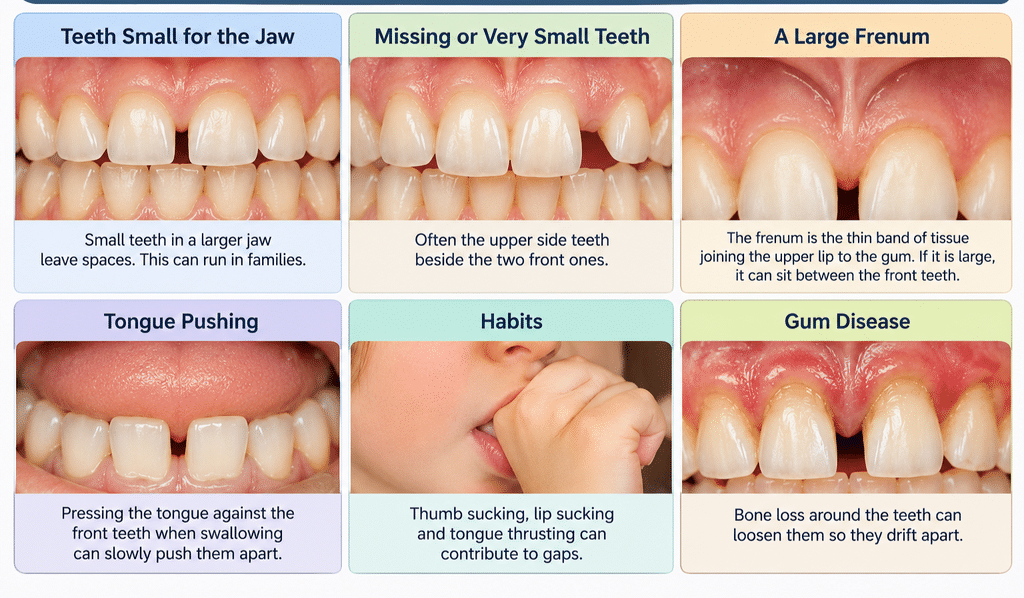
When gum disease is behind a gap, the gums need care first. If the gap is increasing gradually, get it examined by a dentist because gum disease causes bone loss, which increases the gap, so immediate treatment is necessary. The dentist treats the gum disease before anything is done about the gap.
Step 2: Decide whether it needs fixing at all
Teeth gap treatment in Dubai is not usually necessary for medical reasons. Unless an infection is behind it, a gap is nothing to worry about. Closing a gap is mostly a cosmetic choice, which is why it falls under Cosmetic Dentistry.
That means the decision is personal. If the gap does not bother the person, leaving it alone is a perfectly valid choice. If it affects confidence, several options are available to fix the gap between teeth.
Step 3: Meet the options for diastema closure
Diastema closure comes down to three routes:
01. Close the gap without moving teeth
- Dental bonding: It is a tooth-coloured resin that fills the gap and is then shaped and polished. The resin is hardened with a light. Bonding can be completed in a single appointment and suits small to moderate gaps. It is considered the quickest option.
- Porcelain veneers: These are custom ceramic shells attached to the front of the teeth. They suit gaps caused by small teeth. Veneers usually take two to three visits and, with proper care, can last more than 10 years.
- Crowns: Crowns are used when small, misshapen, or weakened teeth cause the gap. This is a bigger step than bonding or veneers, so it is usually saved for teeth that need more than a cosmetic touch-up.
02. Move the teeth
Braces or clear aligners move the teeth closer together, typically for larger gaps. Moving teeth affects the whole mouth, so a full set may be needed.
- Clear aligners suit mild to moderate spacing, typically take 6 to 12 months, and need to be worn 20 to 22 hours a day.
- Metal braces are fixed by dentists and remain on teeth until the dentist takes them off once the treatment is completed.
03. Fix the cause first
- Frenectomy: A quick operation that reduces a thick frenum when it is the cause of the gap. In younger children, the gap may close on its own afterwards, while older children and adults may still need braces. Dentists often combine this procedure with bonding or veneers to close the gap.
- Replacing a missing tooth: If a missing tooth is the reason for the gap, a bridge or an implant can fill the space. A bridge is anchored to healthy teeth on each side, and an implant is a titanium post that holds a crown.
- Gum treatment: For gum disease, the first step is a deep clean called scaling and root planing. Moderate to advanced cases may need gum surgery.
Can “close a gap without braces” be a realistic approach?
Many people want to escape tough procedures and find ways to close a gap without braces. However, it depends on the size of the gap.
- For a small or medium gap in healthy teeth, bonding or veneers are often enough. They build up the teeth, so nothing has to move.
- A bigger gap, or teeth that are spaced out all over, usually calls for moving the teeth with braces or aligners.
- Sometimes there’s a reason behind the gap, like a large frenum or a missing tooth, and that needs to be treated too.
Clear aligners are one way to move teeth without metal braces.
A quick match-up guide
| Situation | Option a dentist may discuss |
| Small gap, healthy teeth, wants a fast fix | Bonding |
| Small teeth, wants a polished look | Veneers |
| Larger or multiple gaps | Braces or clear aligners |
| Large frenum between the front teeth | Frenectomy, often with another treatment |
| Missing tooth causing the gap | Bridge or implant |
| Gap widening, gums bleeding or loose teeth | Gum check and treatment first |
The best way to assess this is to get your teeth examined by a dentist. He will guide you on which option is better to go with.
What to look for in teeth gap treatment Dubai
Anyone searching for teeth gap treatment Dubai clinics will find plenty of choices, so a few practical checks help:
- Ask for the cause to be explained. A good plan starts with why the gap is there, not only how to hide it.
- Ask about options. Bonding, veneers, and moving the teeth suit different gaps, and a dentist should be able to explain the pros and cons of each.
- Ask for a written quote.
- Ask about the long term. Find out how the result is looked after and what happens if it chips or the teeth shift.
Looking after the result
In cases where the reason behind the tooth gap is gum disease or habits, good oral hygiene helps:
- Brushing twice a day
- Flossing daily
- Regular check-ups
- Avoiding thumb sucking
- Correcting swallowing patterns
Experts recommend dental exams and cleanings at least every six months. It is not possible to prevent every case of diastema, so regular visits are the best safety net.
When to see a dentist
A dental visit is a good idea if:
- The gap makes the person self-conscious, and they want to explore options
- The gap is getting wider
- The gums bleed, or the teeth feel loose
- A child’s gap has not closed after the adult teeth have come in
Extract of discussion
It’s totally a patient’s choice to get dental treatment to fix gap between teeth. Otherwise, it is not harmful. However, if the reason behind the gap is some sort of gum infection or habits, then it is better to consult a dentist to get it diagnosed and then decide. For a first opinion, Klinika Dental Clinic Dubai is a clinic worth consulting. A visit there is a simple way to have the gap examined, the cause explained, and the treatment options laid out in writing.
FAQs
01. What is a diastema?
A diastema is simply a gap between teeth, and the most common spot is the middle of the upper row, between the two front teeth.
02. What causes a gap between the teeth?
Common reasons include:
- Small teeth in a larger jaw
- Missing or very small teeth
- A large frenum (the band of tissue joining the upper lip to the gum).
- Pressing the tongue against the front teeth when swallowing
- Thumb or lip sucking
- Gum disease
03. Is a gap between the teeth harmful?
For medical reasons, treatment is not usually needed. It is up to the patient’s choice whether he or she wants to fix it to improve their smile or not. However, the reason behind the gap should be known, as it can be due to gum disease, which keeps on increasing if the disease is not treated immediately.
04. When should a gap be checked by a dentist?
Get it checked by a dentist if:
- Child’s gap hasn’t closed after the adult teeth have come in
- Gap is getting wider
- Gums are bleeding
- Teeth feel loose
05. Is it possible to close a gap in the teeth without braces?
Yes, it is possible to do so with bonding, veneers, or clear aligners.
- Bonding uses tooth-coloured resin shaped to fill the space
- Veneers are custom ceramic shells attached to the front of the teeth
- Clear aligners are without metal braces.