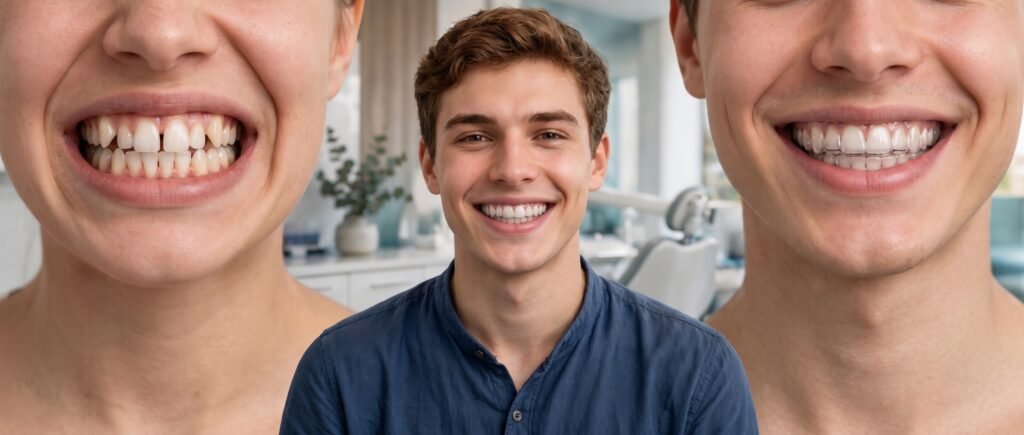
Do clear aligners come to mind?
It feels easy for some patients to go for this option because they are almost invisible and easy to put on, unlike metal braces.
But can aligners fix crooked teeth?
This is the question people worry about because, with convenience, good results are also expected.
Social media makes it look effortless, like:
- Pop in the trays
- Wait a few months
- Enjoy the big reveal
It seems so easy from a social media perspective. Real life is a bit different from what a quick 30-second reel shows. These custom-made plastic trays are very good at some jobs, less reliable at others, and they depend heavily on one thing most adverts skip, which is:
“The person wearing them”
Yes, it depends on you. How patiently and obediently you wear them, according to your dentist’s instructions. Dentist alone cannot help to achieve the wanted results. Mutual efforts and honesty from the patient’s side are needed.
First, a 30-second primer
Clear aligners are:
- Custom-made according to the teeth structure of a patient
- Removable plastic trays
The procedure starts by making a series of trays which are designed by an evaluation of a patient’s jaw and teeth structure. Dentists carry out various scans and also take impressions of the teeth, so trays are made with great precision. Each set of trays nudges the teeth a little further along. Once treatment ends, a retainer may be recommended to hold the new position.
Case Files
Let’s have a look at a few cases to clear the vision:
Case file 1: “My front teeth overlap.” Can aligners fix crooked teeth?
- The situation: The teeth are crowded. There isn’t enough room, so some of them twist, tilt, or sit in front of their neighbours.
- The answer: Often, yes, as long as the problem isn’t severe. Clear aligners are commonly used to treat mild to moderate orthodontic issues, and crowding that isn’t extreme usually falls in that range.
- The small print: Not every crooked tooth moves equally well. A clinical review published by Oral Health describes rotations, meaning teeth that are twisted around their axis, as the least predictable movement for aligners. That doesn’t mean twisted teeth can’t be treated. It means the orthodontist may plan extra steps, or adjust the plan partway through.
Source: https://www.oralhealthgroup.com/features/effectiveness-and-predictability-of-clear-aligner-therapy/
- The verdict: A good candidate for mild to moderate crowding. For severe crowding or very twisted teeth, an orthodontist will say whether aligners, braces, or a mix is the better call. Clear aligners may not be appropriate for every patient.
Case file 2: “There’s a gap I can’t stop noticing.” Invisalign for gaps
- The situation: A visible space between two or more teeth, often the front ones.
- The answer: In such cases clear aligners are appropriate option to go with most of the time. Small gaps usually sit within the mild to moderate range that aligners are commonly used for, though the orthodontist advises them after proper examination of the mouth.
- The small print: The size of the gap matters, and so does the reason behind it. A gap may be due to:
Missing teeth
A jaw that is simply larger than the teeth it holds
That’s why the orthodontist checks the cause before promising anything.
Staying power matters too. Closing a gap is only half the job, and keeping it closed is the other half. A retainer may be recommended after treatment, so it’s worth asking about retainers right from the start.
- The verdict
Often a strong candidate for Invisalign for gaps, particularly when the gaps are on the smaller side. Larger or more complicated spaces need a proper assessment first.
Case file 3: “My top teeth stick out over my bottom ones.” Invisalign for overbite
- The situation:The upper front teeth overlap the lower ones by more than they should.
- The answer: Sometimes. This is the trickiest of the three.
- The small print: The Oral Health review explains why. Because of the way aligners sit over the back teeth, they can have a “bite-block” effect that makes a deep overbite harder to reduce. The review also notes that newer techniques, including built-in “bite ramps”, are helping dentists manage this better than before.
Source: https://www.oralhealthgroup.com/features/effectiveness-and-predictability-of-clear-aligner-therapy/
Aligners work well to improve many issues, but it does not mean that they suit everyone. Overbites are a perfect example. A mild one may respond nicely, while a bigger one, especially when the jaw itself is part of the problem, may call for braces or a different approach.
- The verdict: Invisalign for overbite can work, but it’s very much a “depends on who’s asking” answer. An accurate diagnosis comes first, which brings us to the next section.
The scoreboard
Here is how the three case files stack up. This is a summary of the points above, not a
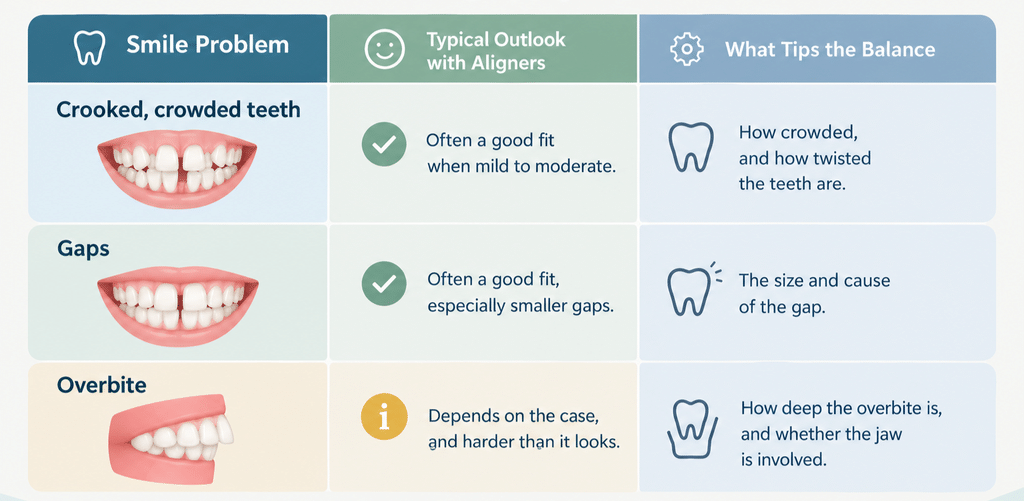
promise for any individual smile.
Trays only work when they’re in and proper care is given
- Wear aligners as instructed by your dental specialist, i.e., 22 hours a day. This is because treatment is halted when they are out of the mouth.
- Aligners come out for eating, and teeth should be clean before the trays go back in.
- Avoid soft drinks, flavoured waters, and sports drinks while wearing them.
- Because they’re removable, they’re also easy to lose or damage.
As for the timeline, aligner treatment can take anywhere from six to 18 months. The exact length depends on the teeth and how closely the trays are worn.
What clear aligners results really depend on
When people ask about clear aligner results, they usually mean “how good will my smile look?” The honest answer is that results come from a handful of things working together:
- A proper diagnosis: The orthodontist reviews X-rays, photos, and models, then builds a custom plan.
- The person behind the plan: The skill of the treating orthodontist matters more than which appliance is used.
- Consistent wear: Depends on the honesty of the patient wearing them and how consistent and disciplined he or she is in following their dentist’s instructions.
- Regular check-ups: In-person exams by a dentist or orthodontist can help lower the risk of problems.
- A retainer afterwards: If the orthodontist recommends one.
A quick word on mail-order aligners
Some companies sell aligners straight to customers, with no in-person visit. Experts say using clear aligners without proper professional supervision may increase the risk of complications. They should not be purchased or sold without a prescription from an orthodontist.
Patients should be aware of this fact and get a real exam first. If the teeth or gums aren’t healthy to begin with, or if the bite problem is bigger than it looks, an in-person check is what catches it. Only an expert orthodontist can do it.
Aligners or braces? Two ways to think about it
People often compare clear aligners and metal braces. There is a difference between the usage of both. Braces are fixed to the teeth, so a person doesn’t need to remember or adjust them by themselves. Whereas clear aligners can be taken off during meals or cleaning. A person may forget to put them back on. So they have to be cautious about the time they put them on and take them off. Clear aligners work only when they are put on.
Aligners may not be appropriate for every patient, so the right match depends on the teeth, the habits, and the orthodontist’s advice.
The final verdict
So, can aligners fix crooked teeth? The answer is yes if the condition of gaps is mild to moderate. Severe cases are treated with a mix of treatments. Here, your orthodontist can examine and suggest the best plan, and you can consult Dental clinic in Dubai like Klinika Dental Clinic.
After all, aligners are a great tool, but the tool is only half the story. The rest is the plan, the wearer, and the follow-through.
FAQs
1. What’s the biggest difference between aligners and braces?
Braces are fixed to your teeth by the dentist. Only the dentist can adjust them and can take them off when adjustments are needed. Whereas aligners can be easily taken off when you are going to have a meal or want to clean your aligners and your teeth. Braces work 24 hours, while aligners work only when they are put on.
2. Are mail-order aligners safe?
No, they are not safe to use because every case is different, so teeth should be examined by an orthodontist. He will assess your gums and teeth health. Specifically, your bite.
3. How do I find out if aligners suit my case?
The only reliable way is a proper assessment. An orthodontist will recommend the best treatment plan after:
- A proper checkup of your teeth
- Bite
- Overall oral health
4. Do I have to wear a retainer once my aligner treatment is done?
In most cases, yes. Aligners bring your teeth to a new position, so to keep that new position, retainers are suggested by orthodontists to wear for good results at the end of the treatment.
5. Can aligners fix an overbite?
Sometimes. Mild overbites can often improve with aligners, but deeper or more complicated ones may need braces or a different treatment along with aligners.