Observe its growth silently or contact a dentist?
An impacted wisdom tooth sometimes sits quietly at the back of your mouth, and sometimes it causes pain, swelling, and infection that need to be checked and treated immediately.
Usually, a person has four wisdom teeth. They are at the back of the jaws, i.e., two above and two below. They arrive last, usually after the rest of the teeth have taken their places. That’s why they are also called last adult teeth. If the jaw doesn’t have the space, the tooth can’t come through the gum properly or grow into its normal position. Dentists call that an impacted wisdom tooth.
Types of impacted wisdom teeth
There are two kinds of impacted teeth:
Partially impacted
In this case, a small part of the wisdom tooth erupts from the gum. A little part of the crown is visible; the rest of the tooth stays inside the gum.
Fully impacted
This type of tooth cannot break through the gum line to come out and stays inside.
The tooth can also sit at different angles. It may:
- Lean toward the next tooth
- lean toward the back of the mouth
- lie sideways in the jawbone
- grow straight but stay trapped
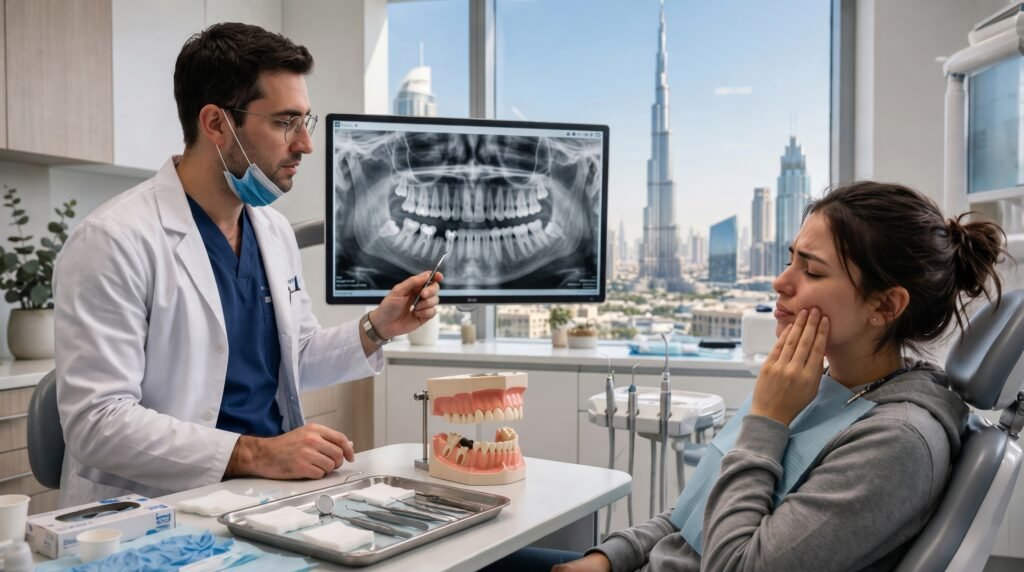
A dentist examines your mouth and takes X-rays to confirm which type of impacted wisdom tooth it is.
It may not hurt
It’s not necessary that an impacted wisdom tooth show symptoms.
Symptoms usually appear when the tooth:
- Becomes infected
- Damages nearby teeth
- Causes other dental problems
Pain-free does not necessarily mean disease-free, so get your wisdom tooth checked every year whether they hurt or not.
Wisdom teeth symptoms to watch for
The following are the wisdom teeth symptoms:
- Red or swollen gums
- Tender or bleeding gums
- Jaw pain, which is the classic wisdom tooth pain
- Swelling around the jaw
- Bad breath
- An unpleasant taste in the mouth
- Difficulty opening the mouth
See a dentist if there are symptoms in the area behind the last molar because having one of these doesn’t prove the cause is a wisdom tooth, because other dental problems can look similar.
Swollen gum behind the last tooth
One of the most common complaints is a swollen gum behind the last tooth in the lower jaw. A frequent cause is a condition called pericoronitis, an inflammation or swelling of the gum tissue. It most often affects the lower teeth, usually around wisdom teeth.
It happens when a wisdom tooth only partly comes through. A flap of gum can sit over the tooth, and bacteria, food, and plaque can get trapped underneath, which can lead to infection. Partially impacted teeth also make this painful gum problem more likely.
Signs of pericoronitis include:
- Pain and swelling in the gum
- A bad taste in the mouth
- Difficulty opening the mouth and jaw
- Pus,
- Pain when swallowing
- Fever
- Swollen glands in the neck
At home, as a first aid treatment, you can rinse your mouth gently with warm salt water and take pain relievers to pass the time until you reach the dentist.
A dentist will:
- Flush the area
- Prescribe a rinse
- Give antibiotics
- For severe or recurring cases, he may suggest oral surgery to remove the gum flap or the wisdom tooth itself.
The situation is more serious and may point towards a life-threatening infection if there is:
- Face swelling
- Swollen lymph nodes
- Jaw spasms
Never ignore swelling and pain, especially when it spreads gradually from the tooth to the jaw and then the cheeks. Especially when it interferes with swallowing or makes it tough to breathe properly.
What can go wrong if the tooth stays stuck?
Several problems linked with impacted wisdom teeth:
Nearby teeth can be damaged
A stuck wisdom tooth applies pressure on nearby teeth and can damage them. This can lead to serious infections. Moreover, teeth crowding occurs.
Cyst development may take place.
Fluid-filled sacs can damage the jawbone, teeth, and nerves. A usually benign tumour. is rare
Bacteria can cause decay.
Partly erupted teeth are hard to clean, so food sticks easily, and when proper cleaning is not done, bacteria develop that begin to eat away at the tooth, drilling cavities in the wisdom tooth and the teeth nearby.
Gum disease may develop.
Pericoronitis becomes more likely around a partly erupted tooth
These issues are not seen in every patient with an impacted wisdom tooth. However, they are the reasons dentists look closely at the ones that don’t come through properly.
So when should an impacted wisdom tooth be removed?
Removal is usually advised when there are problems such as:
- Infections or gum disease, such as the development of pus
- Cavities that can’t be restored
- Cysts
- Fever
- Changes in the bone
- Damage to neighbouring teeth
- Recurring infection of the gum flap
- Pain at the back of the jaw that keeps returning or doesn’t settle
- A swollen or bleeding gum behind the last tooth
- Difficulty opening the mouth fully
If anyone is facing the above-mentioned issues, then the dentist may consider tooth extraction. Otherwise, just monitoring may be enough when there are no problems. For healthy, well-positioned teeth, experts recommend:
- Regular professional cleanings
- Annual check-ups
- Periodic X-rays to watch for changes
Removal of an impacted wisdom tooth is decided in consultation with the dentist because they can better analyze the condition with X-rays.
Quick myth check
People often think that if there is no pain in the impacted wisdom tooth, everything is ok and it does not need to be checked by a dentist. Sometimes, it can cause damage without hurting or showing any immediate signs. Therefore, if you have one then get it checked by a dentist on yearly basis so he can monitor any issues if arising.
Another myth is that every wisdom tooth must come out. This is also not true because if a wisdom tooth is healthy, well-placed, and its cleaning is easy and done properly, then just monitoring its growth is enough. Extraction is not appropriate for such a tooth.
Surgery is not always the solution. As many people think, a swollen gum at the back always means surgery. No, this myth is not true. Surgery is still the last option. A good dentist always finds and suggests non-surgical methods for protection at first. Mild cases often settle with cleaning, rinses, and sometimes antibiotics. Surgery is for severe or repeated trouble.
The takeaway
Removal of an impacted wisdom tooth is always the last option any dentist recommends. Their first try is to protect the natural tooth. If the condition is worse and non-surgical methods fails to protect then dentist go for the extraction decision. Connect with the right dental clinic for honest advice, like Klinika Dental Clinic in Dubai. They understand how precious natural teeth are and provide you experts that help to find best possible ways and treat well.
FAQs
01. What is an impacted wisdom tooth?
An impacted wisdom tooth is one whose position is disturbed by already existing teeth in the jaw. It is of two types:
- Partly impacted, i.e., part of it comes out
- Completely impacted, i.e., stays beneath a layer of gum.
02. What is the reason that causes wisdom teeth to get stuck?
In some jaws, there is less space for wisdom teeth to grow properly, because of which they are trapped and can not erupt properly out of the gum. Its position is disturbed by teeth that already sit in the jaw.
03. Do impacted wisdom teeth always cause pain?
In some cases, an impacted wisdom tooth doesn’t always cause symptoms, and it can stay silent for years. Being pain-free doesn’t necessarily mean being problem-free, which is why a yearly check-up is a good idea even when the tooth feels fine.
04. Why does swelling develop in the gum behind the last tooth?
This condition is called pericoronitis, which is an inflammation of the gum around a wisdom tooth that has only partly come through. In this situation, a tiny flap of gum stays on the partly erupted tooth. This becomes a place where food and plaque get stuck underneath, and bacteria get room to grow and destroy the tooth.
05. What helps a swollen gum while waiting for an appointment?
Gentle rinsing with warm salt water can ease mild cases, and over-the-counter pain relief may help. Ask the dentist or pharmacist which painkiller is right, since advice varies from person to person.